Level Up Your Library: How to Read (and Trust) Game Reviews in 2025
Gaming backlogs are stacked, prices keep climbing, and every trailer looks “game of the year” in 4K. But not every hyped release deserves your time, money, or SSD space. That’s where game reviews come in—if you know how to read them like a pro.
This guide breaks down how to spot legit reviews, dodge hype traps, and use both critics and community voices to build a game library you actually love, not just one that looks cool in screenshots.
What Makes a Game Review Actually Useful?
A good review isn’t just “10/10, peak fiction” or “trash, uninstalled.” It answers one core question: Is this the right game for YOU? To do that, solid reviews usually include:
- Clear context – What kind of game is it? Who is it for? What were the devs trying to do?
- Concrete examples – Instead of “combat feels bad,” they explain why: animation delay, poor hit feedback, weird AI, etc.
- Strengths and weaknesses – Even the best games have flaws; even messy games have bright spots.
- Transparent platform & settings – Was it reviewed on PC, PS5, Xbox, Switch? Performance can change everything.
- Disclosure of freebies – If they got a review code or sponsorship, that should be stated somewhere.
When a review gives you enough detail to imagine how the game feels to play—moment-to-moment—that’s a keeper. If it’s just repeating the trailer buzzwords, move on.
Scores, Stars, and “Mid”: Decoding Ratings Like a Gamer
Scores are flashy, but they’re only the surface layer. Before you slam that “mixed reviews, must be trash” take, keep this in mind:
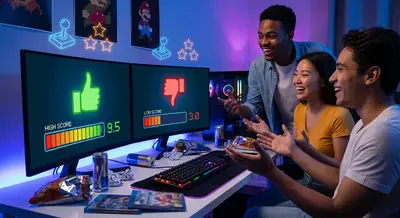
- 7/10 is not a failure. On many pro sites, 7 means “good but not special,” not “doomed.”
- Different outlets use scales differently. A 6 from one site might mean “fine but flawed,” while another barely hands out 9s at all.
- User scores skew emotional. Players are more likely to leave a review when they’re very happy or very mad.
- Day-one reviews miss long-term updates. Live-service and online titles especially can change dramatically over months.
Use scores as a starting point, not a verdict. Read the text (or watch the video) and ask: Why did they land on that number? Do those reasons align with what matters to you?
Single-Player vs Multiplayer: Different Reviews, Different Mindset
Not all games should be judged by the same checklist. Reviews for these genres should feel different:
Single-player / Story-driven games
Look for reviews that talk about:
- Story pacing and characters – Are you actually invested, or just skipping cutscenes?
- Variety in gameplay – Does combat/stealth/platforming evolve, or stay samey after 5 hours?
- Level and world design – Is exploration rewarding, or just map marker cleanup?
- Difficulty options – Can you tune it for chill story mode or sweaty challenge?
If a review spends most of its time on graphics and vibes but barely touches how the game actually plays for 20+ hours, that’s a red flag.
Multiplayer / Co-op / Live-service games
Here, long-term design and community health matter:
- Netcode & matchmaking – Lag, desync, or long queue times can kill even great mechanics.
- Balance & meta – Is one build, weapon, or strat dominating everything?
- Progression systems – Are unlocks satisfying, or just grindy padding?
- Monetization – Battle passes, cosmetics, boosters—does it feel fair or predatory?
- Post-launch plans – Is there a real roadmap or just vague promises?
The best reviews of multiplayer games either revisit them months later or clearly say, “We’ll update this once the meta and content settle.”
Red Flags: How to Spot a Sus Review
Not every review is created equal. Some are rushed, influenced, or just low-effort. Watch out for:
- No specifics, only vibes: “Gameplay is amazing” with zero examples. Sounds like marketing, not critique.
- Over-fixation on graphics: If they barely mention controls, performance, or game systems, be careful.
- Obvious bias: “I hate JRPGs, but here’s my JRPG review.” Pass.
- Copy-paste of dev talking points: If it reads like the Steam description, that’s sus.
- No mention of bugs or performance: Especially for PC—port quality matters a ton.
On video platforms, be wary of thumbnails screaming “BROKEN”, “UNPLAYABLE”, “SCAM” over a game that’s having normal launch issues. Outrage gets views; it doesn’t always get you the truth.
Your Playstyle Matters More Than the Metacritic Average
A game can be “objectively” mid and still be your new obsession. To use reviews properly, you need to know your own gamer profile:
Ask yourself:
- Do you value story more than mechanics?
- Do you prefer short, polished experiences or long, grindy ones?
- Are you okay with jank if the ideas are creative?
- Is performance (FPS, input latency) a dealbreaker for you?
Then, in reviews, laser-focus on sections that hit your priorities. Example:
- If you love narrative: skip straight to commentary on writing, voice acting, and choices.
- If you’re a combat junkie: look for breakdowns of builds, boss design, and enemy variety.
- If you’re time-poor: see how many hours to finish, how much filler there is, and whether side content is worth it.
A 6/10 game with incredible systems and bad story might still be a 9/10 for you if you don’t care about cutscenes at all.
Pro Critics vs Player Reviews: Using Both Without Getting Lost
You’ve got two big data streams: professional critics and player/user reviews. Both are useful; both have pitfalls.
Professional critics
Pros:
- Usually play under time pressure but still more thoroughly than casuals.
- Understand genre history and can compare to older titles.
- Often test on multiple platforms.
- Disclose technical issues clearly.
Cons:
- Personal taste still matters.
- Sometimes review on pre-release servers or early patches.
- Editorial pressure for fast coverage can mean less long-term insight.
Player reviews
Pros:
- Huge sample size; you see a wider range of experiences.
- Tons of hardware setups on PC—great for performance info.
- People will happily call out bugs, crashes, and shady monetization.
Cons:
- Review bombing (over politics, pricing, or outrage not tied to actual gameplay).
- “0/10 worst game ever” because of one disliked feature.
- Many players leave reviews after only 1–3 hours of play.
Best strategy:
Use critics to get a structured overview, then skim user reviews for patterns:
- Are lots of people mentioning the same performance issue?
- Is everyone either 1/10 or 10/10 with nothing in between?
- Do long-playtime reviews (e.g., 20+ hours on Steam) line up with critic concerns?
Patterns matter more than individual rage posts.
Insider Tips: How to Research a Game Before You Buy
Here’s a battle-tested pre-purchase checklist to avoid buyer’s remorse:
Watch raw gameplay, not just trailers.
Look for unedited, commentary-free gameplay on YouTube or Twitch VODs. Focus on UI, animations, movement, and combat pacing.Check performance from multiple sources.
Search “[Game] PC performance” or “[Game] PS5 vs Series X” and look for benchmark breakdowns. That’s crucial for big AAA releases.Search “bugs” + game name on launch week.
If everyone’s tweeting clips of broken quests, UI glitches, or save corruptions, maybe wait for a patch.Read at least one long-form review and one community thread.
A detailed written review + a Reddit/Steam discussion page will give you both the curated and the raw take.Look for “post-patch” or “re-review” coverage.
Live games evolve. Titles like No Man’s Sky and Cyberpunk 2077 show that a game can go from meme to must-play over time.Use wishlists and backlogs strategically.
Not hyped enough to buy day one? Wishlist it, follow patch notes and reviews, and grab it later on sale once the dust settles.
Honest Opinions: When to Buy, When to Wait, When to Skip
Not every game decision is “buy or don’t.” Think in three tiers:
Day-one buy (full price is worth it) if:
- You love the genre and trust the dev’s track record.
- Early reviews say it’s stable and well-optimized on your platform.
- You want to be part of the launch buzz, co-op scene, or PvP meta.
Wishlist and wait if:
- Reviews say “fun, but buggy” or “great core, needs more content.”
- The game is single-player and won’t really change if you play it later.
- You’re not sure it fits your taste, but it has elements you like.
Hard pass (or deep-sale only) if:
- Reviewers all slam the same core mechanic (e.g., awful controls or pay-to-win).
- The devs double down on aggressive monetization.
- The concept seemed cool, but everyone agrees it’s just not fun to play.
Biggest tip: don’t force yourself to like something just because it’s hyped. If three reviews all say “it’s amazing after 20 hours,” and you hate the first 3, it might just not be for you—and that’s fine.
Conclusion
Game reviews are one of the strongest tools in your loadout as a gamer—but only if you treat them as guides, not commandments. Learn how to read between the lines, match critiques to your own playstyle, and use both pro and player voices without getting caught in the hype tornado.
Do that, and you’ll build a library that’s not just “critically acclaimed,” but personally legendary—packed with games you actually finish, talk about, and maybe even 100% for the flex.
Now go scout those reviews like a pro, and let your next purchase be a clutch W, not a rage-refund.
Sources
- Metacritic – How Metascores Are Generated – Explains how critic and user scores are aggregated and weighted
- IGN – How We Review Games – Detailed breakdown of a major outlet’s review philosophy and scoring system
- PC Gamer – Our Review Policy – Insight into how professional critics evaluate PC games, including performance and long-term support
- Game Developer – The State of Game Discovery – Industry-focused look at how players find and evaluate games today
- BBC – Why Video Games Are Getting Longer – Context on game length, player expectations, and how that affects reviews and value perception